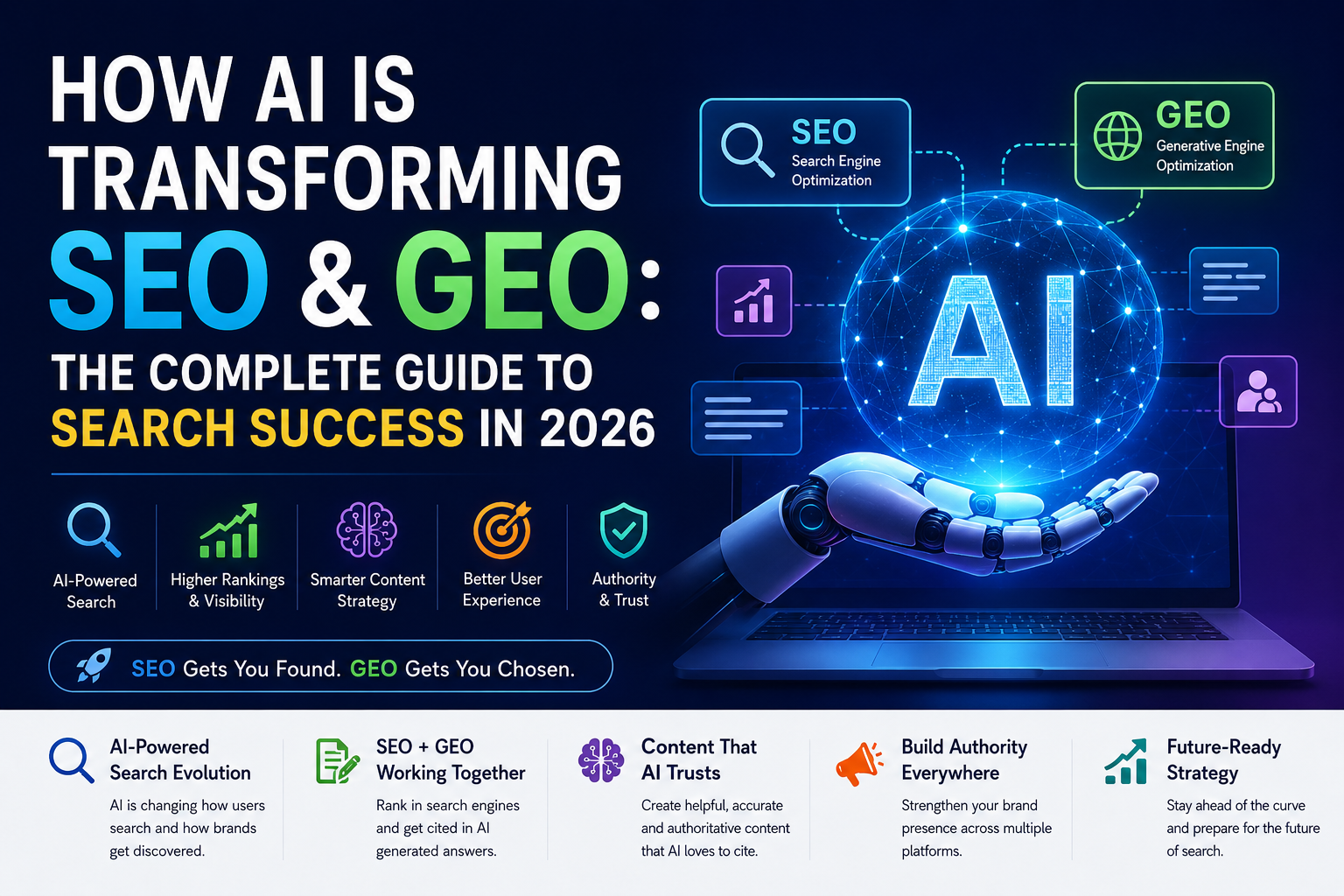
Search is no longer just about ranking on Google. In 2026, businesses face a new reality where artificial intelligence generates answers, summarizes content, and decides which sources deserve visibility. Traditional Search Engine Optimization (SEO) remains critical, but a new discipline—Generative Engine Optimization (GEO)—has emerged to help brands appear inside AI-generated responses from platforms like ChatGPT, Google AI Overviews, Gemini, Claude, and Perplexity.
Recent industry studies indicate that Google AI Overviews now appear on approximately 48% of search queries, while AI-driven search traffic continues growing at triple-digit rates year-over-year. Many websites are experiencing declining click-through rates as users obtain answers directly from AI-generated summaries rather than visiting multiple websites.
The businesses that adapt quickly are gaining a significant advantage. They are not simply optimizing for rankings anymore; they are optimizing for citations, mentions, authority, and trust across the entire AI search ecosystem.
From Traditional Search Engines to AI Search
For more than two decades, search engines operated on a relatively straightforward model. Users entered a query, search engines analyzed billions of pages, and ranked results based on relevance and authority. Businesses focused on keywords, backlinks, technical SEO, and content optimization to secure higher rankings. While this system remains important, artificial intelligence has fundamentally altered the way information is discovered and consumed.
Today’s AI-powered search engines do much more than retrieve information. They interpret intent, synthesize multiple sources, and generate complete answers. Instead of clicking through ten websites to find information, users often receive an immediate response generated by AI. This shift is redefining how brands gain visibility online. Research indicates that AI-generated search experiences now influence a substantial portion of user journeys, making traditional ranking positions only part of the visibility equation.
Why Search Behavior Is Changing
Consumer expectations have evolved dramatically. People want faster answers, personalized responses, and conversational experiences. AI delivers all three. Whether users search through Google AI Overviews, ChatGPT Search, or Perplexity, they increasingly expect direct answers rather than long lists of links.
This behavioral shift has profound implications for marketers. Traffic is no longer the sole measure of success. Brand mentions, AI citations, answer inclusion, and topical authority are becoming equally important metrics. Companies that understand this transition are building content strategies designed not only to rank but also to be referenced by AI systems.
What Is SEO in 2026?
Core SEO Principles That Still Matter
Despite rapid advancements in AI, SEO is far from dead. In fact, many traditional SEO fundamentals remain essential. Search engines still rely on content quality, website performance, authority signals, and relevance to determine which pages deserve visibility.
Successful SEO campaigns in 2026 focus on:
| SEO Factor | Importance |
|---|---|
| High-quality content | Very High |
| Technical SEO | Very High |
| User experience | High |
| Backlinks | High |
| Structured data | High |
| Mobile optimization | Essential |
The difference is that these elements now support both traditional search rankings and AI citation opportunities.
The Role of E-E-A-T in Modern Rankings
Google’s emphasis on Experience, Expertise, Authoritativeness, and Trustworthiness (E-E-A-T) has become even more significant in the AI era. AI systems increasingly favor content that demonstrates real-world expertise and factual accuracy.
A generic article generated with minimal expertise may rank poorly and rarely appear in AI-generated responses. Meanwhile, content backed by industry experts, original research, case studies, and firsthand experience stands a much better chance of being cited. Businesses that invest in genuine authority are seeing stronger performance across both SEO and GEO channels.
What Is GEO (Generative Engine Optimization)?
How GEO Differs from Traditional SEO
Generative Engine Optimization focuses on improving visibility inside AI-generated answers rather than solely targeting traditional rankings. The objective is different. SEO aims to drive clicks from search results, while GEO aims to ensure your brand and content become part of the answers users receive.
Think of SEO as competing for a spot on the shelf, while GEO is competing to become the product recommended directly by the salesperson. The visibility opportunity is far more immediate and influential.
Studies examining AI search behavior show that citation selection is increasingly independent of traditional rankings. High-quality, well-structured, evidence-rich content often earns citations even when it does not occupy the top organic positions.
Why GEO Has Become Essential
The rise of AI-generated search experiences has created a new competitive landscape. Businesses that ignore GEO risk losing visibility even if they maintain strong organic rankings. AI systems are becoming gatekeepers of information, selecting which brands, facts, and sources users see first.
Organizations with coordinated SEO and AI visibility strategies consistently outperform competitors. Research shows that many marketers still operate with fragmented approaches, creating missed opportunities in AI search visibility.
The Impact of AI Overviews and AI Search
Google AI Overviews
Google AI Overviews represent one of the most significant search transformations in history. Instead of displaying only traditional results, Google now generates summaries that answer user questions directly.
Several industry studies report that AI Overviews appear on roughly 48% of tracked search queries, while organic click-through rates often decline when AI-generated summaries are present.
For website owners, this means visibility inside the AI summary can be just as valuable as a top-ranking position. Brands cited within AI Overviews gain trust, recognition, and authority even when users do not immediately click through.
ChatGPT Search and AI Answer Engines
AI search extends far beyond Google. ChatGPT, Perplexity, Gemini, and other platforms are rapidly reshaping information discovery. Industry estimates suggest AI search referrals continue growing rapidly, with ChatGPT leading the market in AI-generated traffic referrals.
The growing influence of these platforms means businesses must diversify their visibility strategies. Optimizing solely for Google is no longer sufficient. Brands need discoverability across the broader AI ecosystem.
Key AI Technologies Changing Search
Large Language Models
Large Language Models (LLMs) are the foundation of modern AI search experiences. These systems understand context, analyze relationships between concepts, and generate human-like responses.
Unlike traditional algorithms that primarily match keywords, LLMs interpret meaning. This shift rewards comprehensive, context-rich content rather than pages designed solely around keyword density. Businesses that create genuinely valuable resources are better positioned to earn AI visibility.
Retrieval-Augmented Generation (RAG)
Retrieval-Augmented Generation, commonly known as RAG, combines real-time search retrieval with AI-generated responses. Rather than relying exclusively on training data, AI systems retrieve current information from trusted sources before generating answers.
This process explains why content quality, authority, and accessibility remain critical. AI models often pull information directly from indexed web pages, making SEO and GEO closely connected disciplines.
Winning SEO Strategies for 2026
Topical Authority
One isolated article rarely dominates search anymore. Search engines and AI systems increasingly reward websites that demonstrate deep expertise across an entire subject area.
Building topical authority involves creating interconnected content clusters that comprehensively cover a topic. For example, a digital marketing website should publish content on SEO, GEO, AI search, content marketing, analytics, technical optimization, and related subjects.
This approach helps search engines and AI models understand your expertise and increases the likelihood of citations.
Semantic Search Optimization
Keyword targeting remains important, but semantic relevance has become equally crucial. Modern search engines evaluate relationships between entities, concepts, and topics rather than focusing solely on exact keyword matches.
Effective semantic optimization includes:
- Answering related questions.
- Using natural language.
- Covering subtopics comprehensively.
- Including structured data.
- Demonstrating expertise through examples and evidence.
This strategy aligns perfectly with how AI models interpret and retrieve information.
Winning GEO Strategies for 2026
Becoming a Citation-Worthy Source
AI systems prioritize sources that provide clear, factual, and trustworthy information. Becoming citation-worthy requires more than publishing content regularly. It requires publishing content that AI systems can confidently reference.
Characteristics of citation-worthy content include:
- Original research
- Industry statistics
- Expert commentary
- Clear definitions
- Structured formatting
- Comprehensive coverage
AI models often favor content that presents information in a concise, authoritative manner.
Multi-Platform Brand Visibility
GEO extends beyond websites. AI systems gather information from blogs, news publications, social media platforms, forums, videos, podcasts, and knowledge bases.
Brands that maintain consistent messaging across multiple channels improve their likelihood of being recognized and cited by AI systems. Research suggests organizations with integrated visibility strategies perform significantly better in AI-driven search environments.
AI Tools Every SEO Professional Should Use
Content Research Tools
AI-powered research tools help identify emerging topics, user intent patterns, and content gaps faster than traditional methods. These tools can analyze massive datasets and uncover opportunities that manual research might miss.
Popular use cases include:
- Keyword discovery
- Competitor analysis
- Topic clustering
- Content brief generation
- SERP analysis
The goal is not replacing human creativity but enhancing strategic decision-making.
AI Analytics and Monitoring Tools
As GEO becomes more important, businesses need new measurement frameworks. Traditional rank tracking alone cannot capture AI visibility.
Modern analytics should monitor:
| Metric | Purpose |
|---|---|
| Organic traffic | SEO performance |
| AI citations | GEO performance |
| Brand mentions | Visibility tracking |
| Engagement metrics | User satisfaction |
| Conversion rates | Business impact |
The most successful marketers combine traditional SEO metrics with emerging AI visibility indicators.
Common Mistakes to Avoid
Many businesses make the mistake of assuming AI can completely replace human expertise. While AI tools dramatically improve efficiency, they cannot replace authentic experience, original insights, and strategic thinking.
Other common mistakes include:
- Publishing thin AI-generated content.
- Ignoring fact-checking.
- Focusing only on keywords.
- Neglecting technical SEO.
- Failing to build brand authority.
- Ignoring AI citation opportunities.
Research continues to show that expertise-driven content consistently outperforms low-quality mass-produced material in both traditional and AI search environments.
The Future of Search Beyond 2026
The search landscape will continue evolving rapidly. AI-generated answers will become more personalized, conversational, and context-aware. Users may increasingly interact with search systems through voice, multimodal interfaces, and intelligent assistants.
Future success will depend on becoming a trusted source of information rather than simply a website competing for rankings. Brands that invest in expertise, credibility, and audience value will remain visible regardless of how search interfaces change.
The distinction between SEO and GEO will likely become less pronounced over time. Instead, businesses will focus on comprehensive search visibility strategies that encompass rankings, citations, mentions, and authority across all digital discovery platforms.
Conclusion
AI is transforming search faster than any technological shift since the birth of Google. Traditional SEO remains essential, but it is no longer sufficient on its own. The rise of AI Overviews, conversational search, and generative answer engines has introduced GEO as a critical component of modern digital marketing.
Success in 2026 requires a balanced strategy. Businesses must continue optimizing websites for rankings while simultaneously creating content worthy of AI citations. Authority, expertise, trust, and comprehensive topic coverage have become the foundation of both SEO and GEO.
The winners in this new era will not be the brands that publish the most content. They will be the brands that publish the most useful, trustworthy, and authoritative content. Search is evolving from a ranking game into a credibility game, and those who understand this shift today will dominate visibility tomorrow.
FAQs
1. What is the difference between SEO and GEO?
SEO focuses on improving visibility in traditional search engine results, while GEO focuses on improving visibility within AI-generated answers and citations provided by platforms such as ChatGPT, Google AI Overviews, and Perplexity.
2. Is SEO still important in 2026?
Yes. SEO remains the foundation of online visibility. Technical optimization, content quality, backlinks, and user experience continue to influence both search rankings and AI citations.
3. What are Google AI Overviews?
Google AI Overviews are AI-generated summaries that appear at the top of search results, providing direct answers to user queries and citing selected sources from across the web.
4. How can businesses optimize for AI search?
Businesses should focus on creating authoritative content, publishing original research, building topical authority, using structured data, and maintaining a strong brand presence across multiple digital channels.
5. Will AI replace traditional search engines?
AI is transforming search rather than replacing it. Traditional search engines continue to exist, but they increasingly integrate AI-generated experiences that change how users discover and consume information.






Leave A Comment