
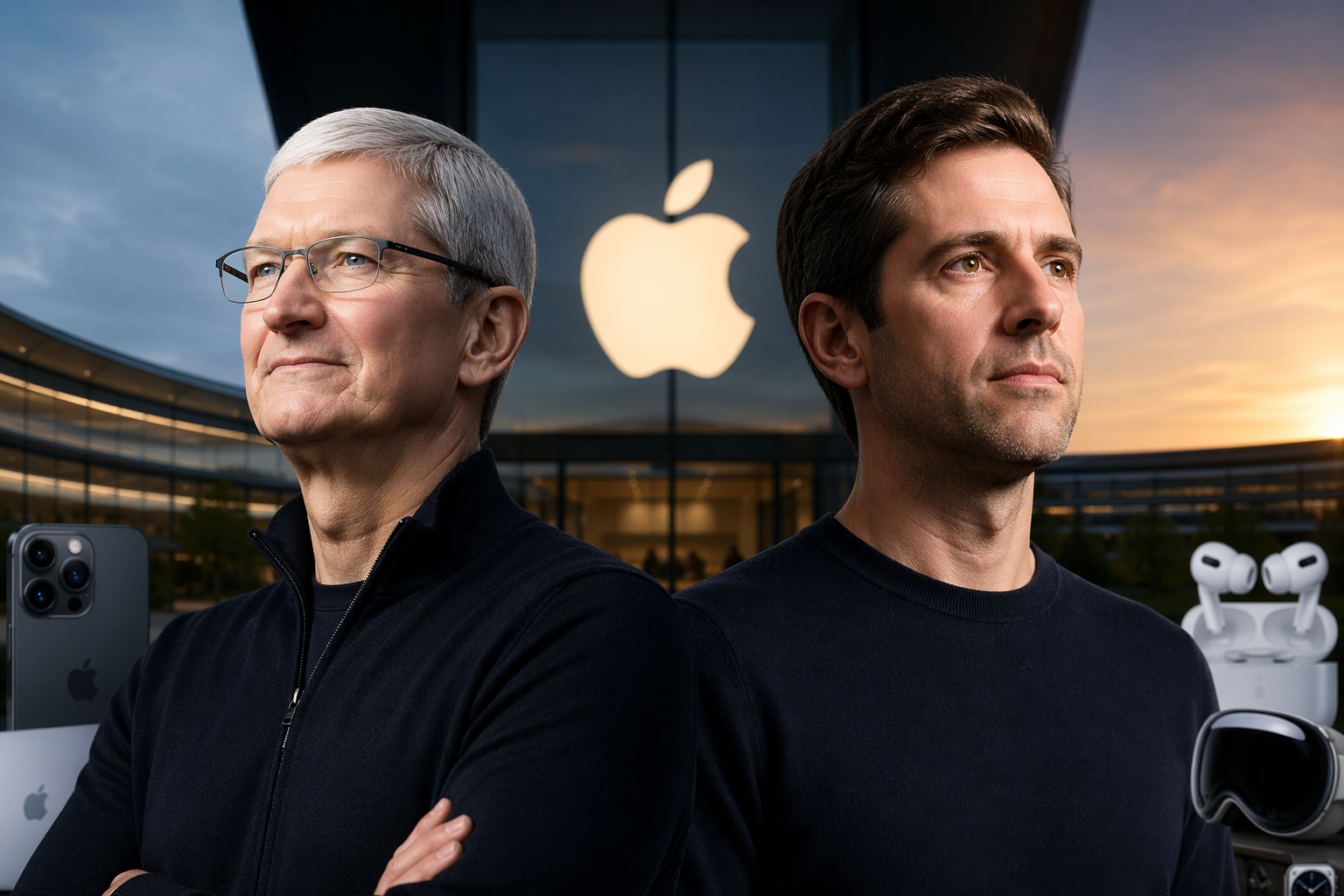
Apple is stepping into one of the most defining leadership changes in its modern history. After more than a decade at the helm, Tim Cook is preparing to transition out of the CEO role, making way for John Ternus, a long-serving Apple hardware executive. This shift is not just a corporate reshuffle—it represents a strategic pivot for one of the world’s most influential technology companies. Leadership transitions of this scale often signal deeper changes in direction, culture, and innovation priorities. Naturally, the tech industry is watching closely.
What makes this transition particularly significant is that Apple has maintained remarkable continuity since Cook succeeded Steve Jobs in 2011. Now, with Ternus stepping in, Apple is again placing its future in the hands of an internal leader deeply rooted in its engineering culture. This move reflects both stability and ambition at a time when the tech landscape is becoming increasingly competitive, especially in artificial intelligence and next-generation computing.
Official Announcement from Apple
Apple’s official statement confirms that Tim Cook will transition to the role of executive chairman while John Ternus will assume the position of CEO starting September 1, 2026. The announcement was approved unanimously by the company’s board, signaling strong internal alignment on the decision.
The transition has been described as part of a long-term succession plan rather than a sudden change. Cook will continue overseeing operations during the summer to ensure a smooth handover. This structured approach reflects Apple’s preference for controlled leadership evolution rather than abrupt executive shifts that could disrupt product cycles or investor confidence.
Key Dates and Transition Timeline
The leadership change follows a clearly defined timeline:
- Cook remains CEO through the summer of 2026
- September 1, 2026: John Ternus officially becomes CEO
- Cook transitions into executive chairman role
- Ternus joins Apple’s board of directors
This gradual transition allows both leaders to collaborate closely during the handover phase, reducing operational friction.
Board Approval and Succession Planning
Apple’s board has emphasized that the decision is the result of years of succession planning. Rather than reacting to external pressure, the company has methodically prepared for leadership continuity. This reinforces Apple’s reputation for long-term strategic thinking rather than reactive corporate governance.
Who is John Ternus?
John Ternus is not a newcomer to Apple’s ecosystem. He has spent over two decades within the company, gradually rising through the ranks of its hardware engineering division. His appointment reflects Apple’s confidence in technical leadership over external executive hiring.
Early Career at Apple
Ternus joined Apple in 2001, initially working within product design and mechanical engineering teams. His early work focused on developing hardware systems that would later support Apple’s expansion into mobile and wearable devices. Over time, he became known internally as a precision-driven engineer with a strong focus on product durability and performance.
Rise to Hardware Engineering Leadership
By 2021, Ternus had been appointed Senior Vice President of Hardware Engineering. In this role, he oversaw core product categories including iPhone, Mac, iPad, Apple Watch, and AirPods. His leadership coincided with Apple’s transition to Apple Silicon, a major architectural shift that significantly improved performance and efficiency across devices.
Major Contributions to Apple Products
Ternus has been directly involved in several major product innovations:
- Transition to Apple Silicon chips in Macs
- Hardware redesigns across iPhone generations
- Expansion of AirPods into health-related features
- Improvements in device sustainability and recyclability
- Advancements in Mac performance architecture
His engineering background gives him a distinctly product-centric leadership style, unlike traditional business executives.
Tim Cook’s Legacy as Apple CEO
Tim Cook’s tenure as CEO has been one of the most successful in corporate history. Under his leadership, Apple evolved from a product-focused company into a global services and ecosystem powerhouse.
Growth of Apple Under Cook
When Cook became CEO in 2011, Apple’s market valuation was significantly smaller than today. Over the years, the company experienced exponential growth, eventually becoming one of the most valuable companies in the world. Revenue expanded across all major product lines, with particularly strong performance in iPhone and services.
Expansion into Services and Global Markets
Cook played a pivotal role in diversifying Apple’s revenue streams beyond hardware. Services such as the App Store, iCloud, Apple Music, and Apple TV+ became multi-billion-dollar businesses. This shift helped Apple reduce dependency on iPhone sales alone and created a more stable long-term financial structure.
Why Apple Chose John Ternus
Apple’s decision to appoint Ternus reflects a deliberate focus on engineering leadership rather than financial or marketing-driven executive selection.
Engineering-First Leadership Style
Unlike many tech CEOs with primarily business backgrounds, Ternus comes from a deep engineering discipline. This aligns with Apple’s identity as a product-first company. His approach emphasizes precision, hardware integration, and long-term product reliability.
Continuity in Apple’s Product Vision
Apple values continuity in design philosophy. Ternus has already played a key role in shaping current product lines, meaning his promotion ensures stability rather than disruption. This internal succession also signals Apple’s confidence in its existing roadmap.
Market and Investor Reaction
Stock Market Response
Following the announcement, Apple’s stock saw only modest movement, reflecting investor confidence in the planned transition. Markets generally interpret internal successions as less risky compared to external leadership changes.
Analyst Opinions
Industry analysts have described the move as “strategically conservative but structurally sound.” Many believe Ternus represents continuity rather than radical change, which could reassure investors during uncertain macroeconomic conditions.
Strategic Challenges Facing the New CEO
AI Competition Pressure
One of the biggest challenges facing Ternus is Apple’s position in artificial intelligence. Competitors have aggressively advanced AI-driven platforms, while Apple has taken a more cautious approach. This gap will likely become a central focus of his leadership.
Product Innovation Expectations
Apple users expect continuous innovation across iPhone, Mac, and wearables. Maintaining that momentum while adapting to new computing paradigms will be a defining test for the incoming CEO.
What This Means for Apple’s Future
This leadership change suggests Apple is entering a phase of engineering-led evolution. Rather than reinventing itself, the company is likely to refine existing ecosystems while gradually expanding into AI-integrated hardware and services.
Ternus’s background indicates a future focused on product depth rather than aggressive diversification. However, the pressure to accelerate innovation in AI and mixed reality will shape his strategic decisions early in his tenure.
Industry-Wide Impact of the Transition
Apple’s leadership shift will influence the broader tech industry. As one of the most valuable companies globally, any change in direction affects supply chains, developers, competitors, and investors.
Companies competing in smartphones, chips, and AI will closely watch how Ternus approaches innovation cycles. His engineering-heavy background may also reinforce a trend where hardware excellence becomes central again in consumer tech competition.
Conclusion
Apple’s decision to appoint John Ternus as CEO marks a carefully planned transition designed to preserve stability while preparing for the next era of technology. Tim Cook’s legacy is deeply embedded in Apple’s global dominance, and Ternus now inherits both its strengths and its challenges.
The coming years will determine whether Apple can maintain its leadership in hardware while accelerating its presence in artificial intelligence and next-generation computing. One thing is clear: this is not just a change in leadership—it is the beginning of a new strategic chapter for Apple.
FAQs
1. When will John Ternus become Apple CEO?
John Ternus will officially take over as CEO on September 1, 2026.
2. What role will Tim Cook have after stepping down?
Tim Cook will become executive chairman of Apple’s board.
3. Why did Apple choose John Ternus as CEO?
Apple selected Ternus due to his engineering expertise and long-term role in product development.
4. How long has John Ternus worked at Apple?
He has been with Apple since 2001, making it over two decades.
5. What are the biggest challenges for the new CEO?
Key challenges include AI competition, product innovation, and maintaining Apple’s ecosystem dominance.






Leave A Comment